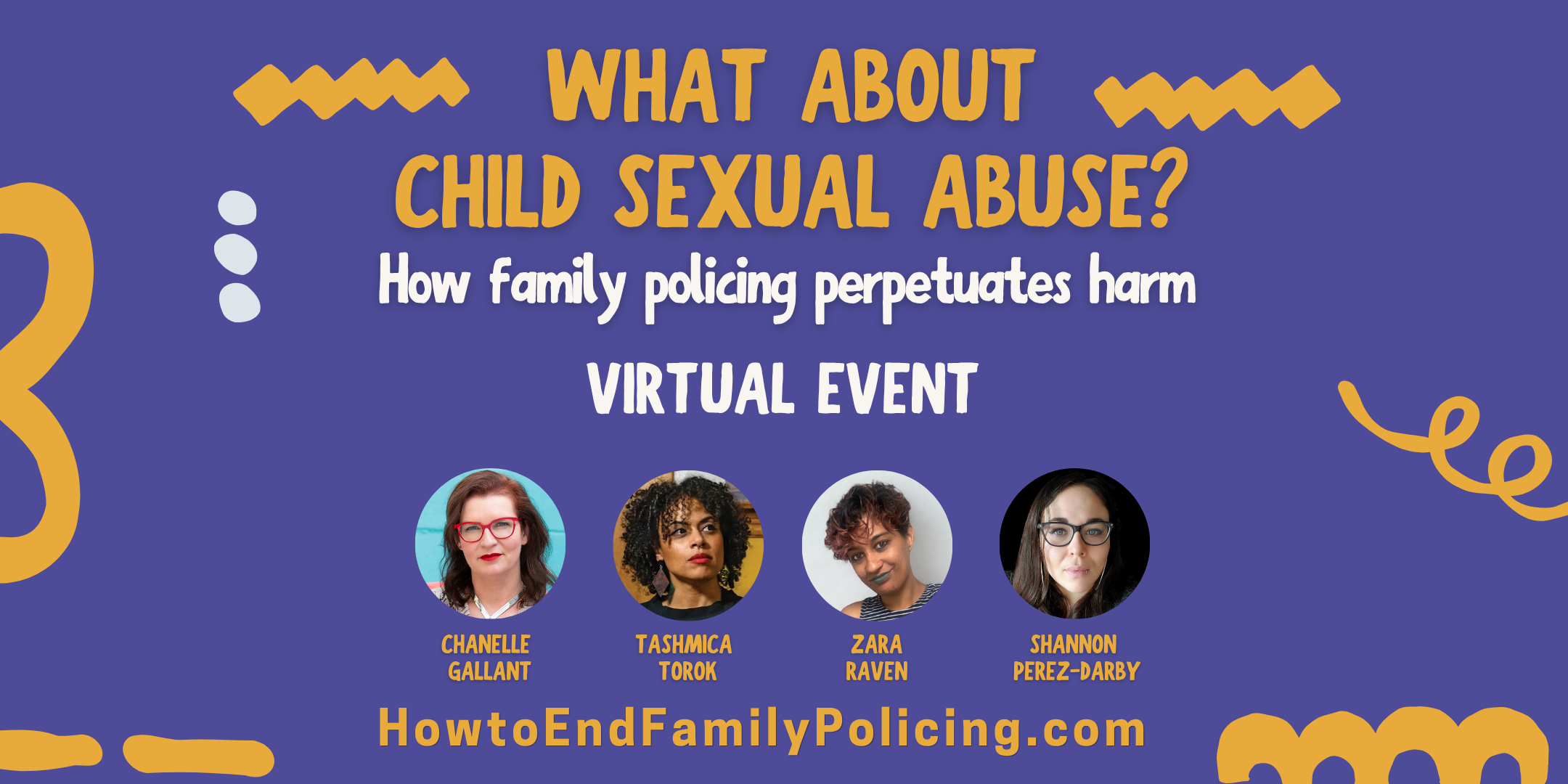
Join abolitionist organizers Chanelle Gallant, Tashmica Torok, zara raven and Shannon Perez-Darby as we discuss how our collective inability to address child sexual abuse perpetuates the harms of family policing.
Many organizers use the term “family policing” rather than “child welfare” to recognize the ways the system surveilles, punishes, and separates families, especially Black, Indigenous and low/no income families, rather than providing for their well-being.Child sexual abuse (CSA) is both a primary justification for these systems and an all too common experience by young people forced to into them.
As we call for the abolition of family policing, even people critical of these systems pause and ask,"But what about child sexual abuse?" Don't we need these systems to keep children safe?"Family policing and mandated reporting are not designed for the safety of children and families yet so many people feel as those these systems are a necessary part of children's safety. This false dichotomy is a trap that limits our visions of what's possible.
Join in this virtual event as we imagine a word that abolishes all forms of policing AND centers the safety and self-determination of young people.
This event will be a panel discussion with time for Q&A. We will be using zoom generated captions. A recording will be available for one month after the workshop for registered participants.
Tuesday, May 26th
4-6 pm ET/3-5 PM CT/1-3 PM PT
Registration is sliding scale $1-25
For questions please reach out to Shannon@accountablecommunities.com
This event is brought to you by the Accountable Communities Consortium, the Mandatory Reporting is Not Neutral project and the How to End Family Policing: From Outrach to Action anthology.
Accountable Communities Consortium uses transformative justice princples to support people, organizationa and communities to be in right relationship with each other.
The Mandatory Reporting is Not Neutral project works to share survivor stories about the impact of mandatory reporting, educate communities on harm reduction practices and change the conditions that lead to violence and abuse.
With contributions from over 20 leading abolitionist organizers, How to End Family Policing: From Outrage to Action is a much-needed intervention arguing that the systems that purport to protect children make them—and our communities—less safe.